
The Wiegmann Lab at North Carolina State University
We study the phylogeny and evolution of flies, primarily using evidence from gene sequences. Our projects focus on using the interrelationships among fly species and higher taxa to understand the adaptations, context, and consequences of fly diversity and its role in shaping biological interactions.
We are particularly interested in describing how specialized feeding habits, specifically parasitism, phytophagy, hematophagy, and fungivory, have evolved in flies repeatedly across many diverse lineages.
Our major projects focus on the new fly tree of life (Diptera), mosquitoes (Culicidae), blow flies (Calliphoridae), true fruit flies (Tephritidae: Anastrepha), and leaf-mining flies (Agromyzidae: Liriomyza)


Phylogenomics & the Fly Tree of Life
We use data from nuclear gene loci obtained through sequencing of genomes, transcriptomes, and gene capture methods, like Anchored Hybrid Enrichment to reconstruct the tree of life for flies and their close relatives among insects. These efforts are supported through our participation in the 1Kite (One Thousand Insect Transcriptome Evolution) Consortium and other international collaborations. As a steering member of the Antliophora Working Group in 1Kite, we are generating and analyzing transcriptomic data sets to provide a new estimate of the Diptera phylogeny that builds on previous work funded by the US National Science Foundation, the Schlinger Foundation, the United State Department of Agriculture, the Australian Commonwealth Scientific Industrial Research Organization and other international government research agencies (Wiegmann, et al. 2011, PNAS).
We are currently developing a new understanding of the history of genetic changes that accompanied fly origins from their closest holometabolan relatives (Meusemann et al., 2020 BioRXV), through investigation of divergence times and phylogenomic sampling; within and among all fly lineages, within cyclorrhaphan Brachycera, and among major lineages of Bibionomorpha.

Culicitree: Mosquito phylogeny
Mosquitoes (Diptera: Culicidae) are a major group of flies and are among the most biomedically important organisms on earth. This is a collaborative project focused on providing a new phylogeny and macroevolutionary context for all world mosquito diversity.
We are collecting genetic and ecological data to test hypotheses relevant to patterns in mosquito ecology and behavior, evolution, vector capacity and the transmission of disease, species interactions and taxonomic identification.

Dimensions of Biodiversity: The evolution of parasitism in blow flies
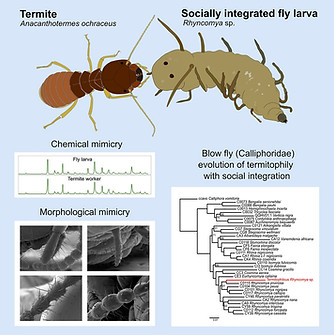
Blow flies (Diptera: Calliphoridae) are a diverse family of calyptrate Diptera with diverse feeding habits that ranges from parasites of snails and millipedes to parasites of livestock and large mammals, exploiters of open wounds, necrophages and decomposers of nearly all kinds of decaying biological material. With over 1,900 known species, their diversity and classification has been difficult to sample in sufficient detail to provide a framework for studying their comparative evolution and ecology.
This project, funded by the US National Science Foundation Dimensions of Biodiversity program and the Brazilian government research agency, FAPESP, brings together an international team to investigate phylogenetic, functional genomic, behavioral and microbiome research to investigate the multiple origins of parasitism in the family through comparison of key pathways to trophic specialization.
A major focus of the project is providing training and research opportunities to students and researchers in the Sao Paulo, Raleigh, and Australian labs.
Improving Diagnostic Identification Tools in the Neotropical fruit fly genus, Anastrepha
Anastrepha are the largest group of fruit flies within Latin America and the Caribbean, containing more than 300 species, many of which are undescribed. They include the most economically important pest species in the region, some that have invaded the US and others that remain serious threats to U.S. agriculture.
Our collaborative project funded by the USDA Farm Bill program uses phylogenomic strategies with Next Generation Sequencing (NGS) methods to investigate a broad range of DNA regions for their diagnostic potential. These data are valuable in providing detailed understanding of species limits and allow us to track and evaluate the rate and spread of specific pests and genes. We are currently developing an interactive web-based framework for rapid identification based on multiple genomic markers.

The evolution and diversification of leaf-mining flies (Agromyzidae)
In collaboration with the USDA Systematic Entomology Lab we are investigating phylogeny and evolution of leaf-mining flies in the family Agromyzidae. We are using Anchored Hybrid Enrichment to generate hundreds of orthologous gene loci to reconstruct phylogeny in these specialized plant feeding flies.
We are working to expand understanding the phylogeny and evolution of these flies to provide a framework for studying tri-trophic interactions (fly/host plants/parasitoids) and the population genomics of major pest species in the globally invasive members of the genus Liriomyza.
